Why MCP Exists: The Integration Problem It Solves
Understand why AI integrations become difficult at scale and how MCP creates a reusable boundary between AI applications and external systems.
Understand why AI integrations become difficult at scale and how MCP creates a reusable boundary between AI applications and external systems.
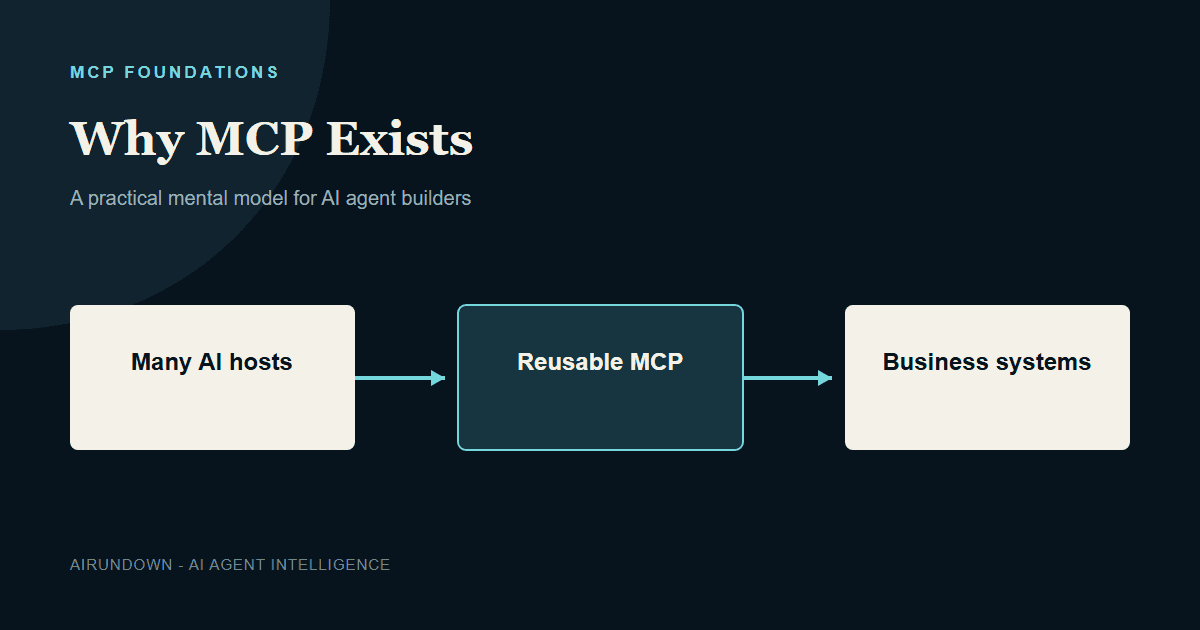
Point-to-point adapters multiply as AI hosts and business systems grow.
MCP exists because connecting one model to one API is easy; maintaining many AI applications across many changing systems is not.
A prototype might give a model one hard-coded function for checking an order. A real company may have a support assistant, an operations copilot, a coding agent, and an internal search experience. Each one may need orders, customer records, policies, files, alerts, and ticket actions. Without a shared boundary, every combination becomes another custom integration.
TL;DR
- Point-to-point adapters multiply as AI hosts and business systems grow.
- The repeated work includes schemas, discovery, credentials, lifecycle, errors, and observability.
- MCP moves capability contracts into reusable servers and gives hosts a consistent client interface.
- MCP does not remove backend APIs, authorization, or good tool design.
- The strongest reason to use MCP is reuse with clear ownership, not trend compliance.
The problem starts after the first successful demo
Imagine one support agent connected directly to an order API. The application stores the endpoint, converts a model tool call into an HTTP request, handles authentication, translates errors, and turns the result back into model context. That is manageable.
Now add a second AI application and five more systems. Each application needs its own descriptions, schemas, credential handling, retries, logging, and compatibility logic. If there are H hosts and S systems, a naive design can approach H x S integration relationships. Not every relationship needs unique code, but teams frequently duplicate enough of it to create drift.
What gets duplicated
| Concern | Repeated question |
|---|---|
| Capability description | What can this system do, and when should the model use it? |
| Input contract | Which fields are required and how are they validated? |
| Discovery | How does the application learn what is currently available? |
| Lifecycle | How do connections initialize, report capabilities, and close? |
| Errors | How are timeouts, invalid input, and domain failures represented? |
| Security | Which identity and permissions apply to this request? |
An API specification can address part of this, but AI hosts also need a consistent way to discover model-facing tools, readable resources, reusable prompts, and protocol capabilities.
The reusable boundary MCP introduces
With MCP, a domain team can expose an order server that owns the model-facing contract for order capabilities. A support host and an operations host each create an MCP client for that server. The server still calls the existing order API, but the clients now share discovery and invocation behavior.
This changes the ownership model. The order team can maintain names, descriptions, schemas, and result shapes close to the domain. Host teams keep control over model choice, user experience, session context, approvals, and which capabilities a user may see.
Why discovery matters
A hard-coded adapter already knows which functions exist. An MCP client can ask a server for current tools, resources, and prompts. The returned definitions include machine-readable schemas that the host can inspect and translate into its model interface.
Discovery does not mean exposing everything. A production host should filter by tenant, user role, environment, risk, and task. A catalog of 200 tools can confuse a model and expand the attack surface. Progressive or task-specific exposure is usually better.
A concrete before-and-after example
Before MCP, three internal assistants each maintain their own Jira integration. One uses outdated field names, one forgets to require confirmation before creating an issue, and one returns errors as unstructured text. When Jira changes, three teams patch three adapters.
After introducing a focused issue-tracker MCP server, the server exposes search_issues, read_issue, and create_issue. It normalizes fields and errors. Each host still chooses whether create_issue requires approval, but the domain contract is maintained once.
What MCP reduces – and what it does not
MCP can reduce repeated protocol glue, capability descriptions, discovery code, and host-specific adapters. It can improve portability between compatible hosts and make integrations easier to inspect with protocol-aware tooling.
It does not design the capability for you. Teams still need narrow operations, meaningful descriptions, downstream credentials, authorization, audit logs, timeouts, tests, and incident response. A reusable bad tool is still a bad tool.
When the extra layer is justified
- Several AI applications need the same domain capabilities.
- Tools or resources change and runtime discovery is useful.
- A domain team should own the capability contract independently of a host team.
- You want comparable local and remote connection patterns.
- Portability across compatible hosts matters.
A direct adapter remains reasonable for one application, one stable service, and no reuse requirement. The correct goal is not maximum MCP adoption. It is minimum accidental integration complexity.
Common mistakes
- Measuring success by server count. Reuse and clarity matter more than catalog size.
- Mixing unrelated domains. One giant enterprise server becomes difficult to permission and own.
- Putting host policy in the server. Shared domain rules belong in the server; user-interface and model policy often belong in the host.
- Exposing all discovered tools. Discovery should feed a policy filter, not bypass it.
My Take
MCP’s deeper benefit is organizational. It creates a place where domain teams can own model-facing capability contracts without tying them to one assistant or one model provider. That separation becomes valuable when the second and third AI applications arrive.
Knowledge check
- Why do point-to-point adapters become expensive as hosts and systems grow?
- Which responsibilities remain with the host after adding MCP?
- Why should a host filter a discovered tool catalog?
Continue learning
Read What Is MCP? for the core mental model, then continue with How MCP Works. For related production concerns, see Tool Permissions and Least Privilege.