AI AgentsLead Story
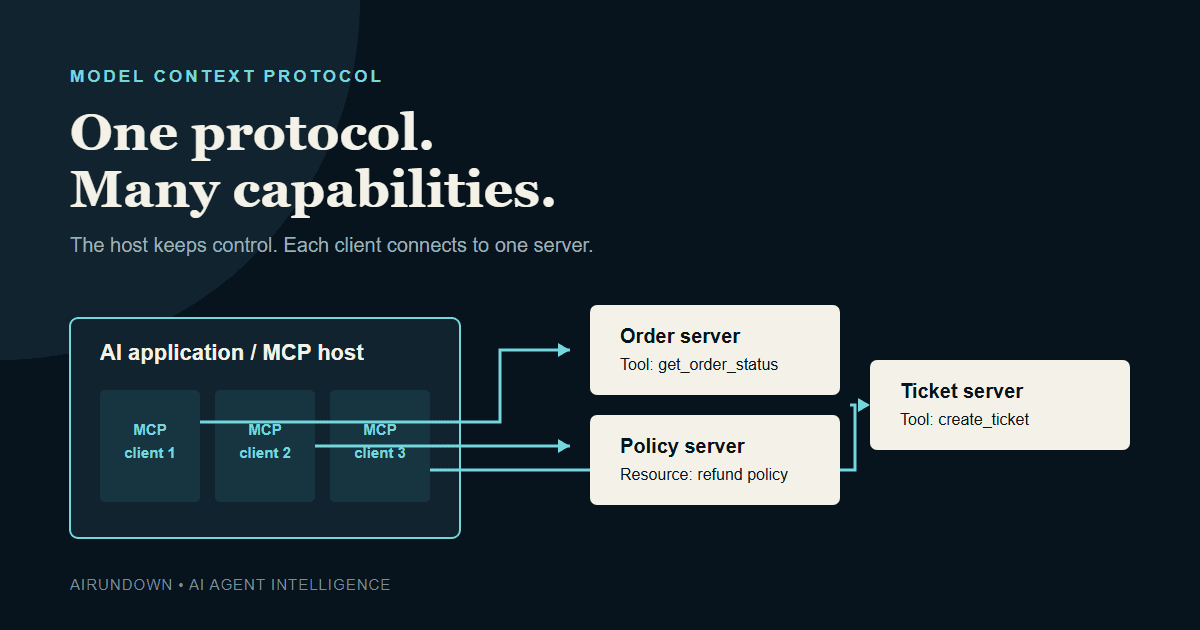
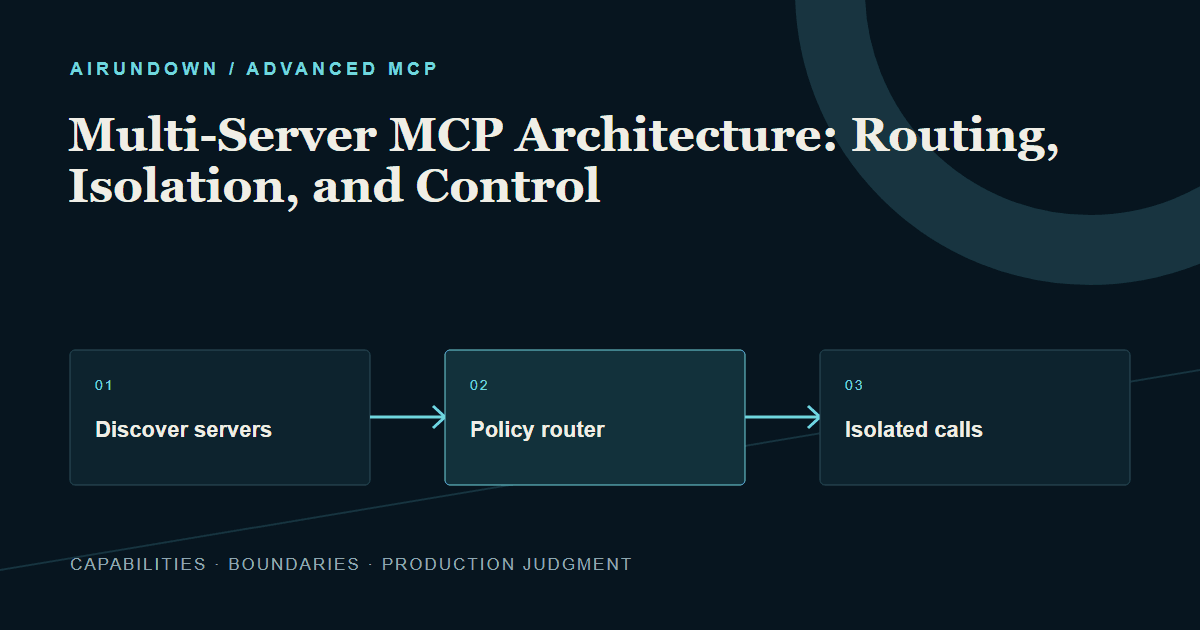
Multi-Server MCP Architecture: Routing, Isolation, and Control
An architecture guide for coordinating multiple MCP servers without creating tool collisions, permission sprawl, or shared failure domains.
AI Rundown Daily delivers independent AI news, research breakdowns, and product strategy insights for product managers, founders, and technical builders.
An architecture guide for coordinating multiple MCP servers without creating tool collisions, permission sprawl, or shared failure domains.
Quantization and training precision get treated as the same thing when a vendor says a model is "smaller" — they aren't. Training precision (BF16, increasingly FP8) is the number format baked in while a model learns; post-training quantization (INT8, INT4) compresses an already-trained model afterward for cheaper serving. The distinction matters more now that FP8 training and aggressive quantization have become standard levers for cutting inference cost. For PMs, knowing which one you're buying changes what quality tradeoff you should actually expect — and what you should test before signing off.
Agentic and function-calling fine-tuning is the specific post-training work — synthetic tool-use trajectories, multi-step reasoning traces, rewards tied to task completion rather than next-token accuracy — that separates models that can actually run an agent workflow from ones that just have a big context window. As of mid-2026, benchmarks like tau-bench and the newly reweighted BFCL v4 show frontier models clustering near parity on single tool calls but diverging sharply on multi-turn, multi-constraint tasks. That divergence is now the signal worth watching as more products get built as agents rather than chatbots. For PMs, the takeaway is blunt: stop evaluating vendors on single-function-call demos and start asking what their post-training actually rewarded.
The real cost of training a frontier AI model in 2026 is far higher than the compute figure quoted in press releases, because that number only covers the final run's GPU-hours. Data licensing, researcher salaries, safety evaluation, and legal compliance stack on top of it, often eclipsing the headline number. This gap is widening as labs push toward $1 billion and $10 billion training runs, reshaping who can credibly compete at the frontier. For PMs, it reframes the build-versus-buy call: the deciding factor isn't GPU pricing, it's whether your company can carry the legal and safety cost structure of an AI lab.
Receive our original briefings, research deconstructions, and systems analysis. Delivered every morning, completely free.
RLHF (Reinforcement Learning from Human Feedback) is the training step that turns a raw, pretrained language model into a usable assistant, using human rankings of outputs to train a reward model, then optimizing the base model against that reward model, typically via PPO. It's the technique behind ChatGPT, Claude, and Gemini's instruction-following behavior, but as of mid-2026 the industry has largely moved on to cheaper successors: DPO for general preference tuning, RLAIF for AI-generated feedback, and RLVR for verifiable-reward reasoning models. The bigger signal is that alignment is getting radically cheaper and more DIY, which changes who can afford to do it well. For PMs, that means the competitive moat of "better-behaved AI" is eroding faster than most roadmaps assume, and in-house preference tuning is now within reach of teams that could never have run an RL pipeline.
Multimodal model training works by converting text, images, and audio into a shared embedding space, then feeding those tokens into either a bolted-on adapter or a natively fused transformer trained end-to-end. The two approaches produce very different capabilities: adapters are cheap and fast to ship, but native fusion is what lets a model reason and generate across modalities in both directions. As of mid-2026, frontier labs are converging on native fusion as the default architecture, and the gap between the two approaches is becoming a competitive divide rather than a rounding error. For PMs, the question isn't which model to buy this quarter — it's whether your product's multimodal roadmap is built on an architecture pattern the industry is quietly abandoning.
LLM pretraining is the next-token-prediction process that turns trillions of tokens of text into a raw base model, the foundational step before any fine-tuning, safety work, or product polish happens. As of mid-2026, frontier runs reportedly cost $200 million to $500 million and increasingly hinge on gigawatt-scale power availability, not just GPU counts, as clusters like xAI's roughly 555,000-GPU Colossus show. That cost curve is reshaping who can credibly compete at the frontier and pushing more industry innovation into post-training and inference-time techniques. For PMs, the pretraining-cost gap is the clearest signal yet for deciding whether your product needs a frontier model's raw capability or can run cheaper on a smaller, fine-tuned one.