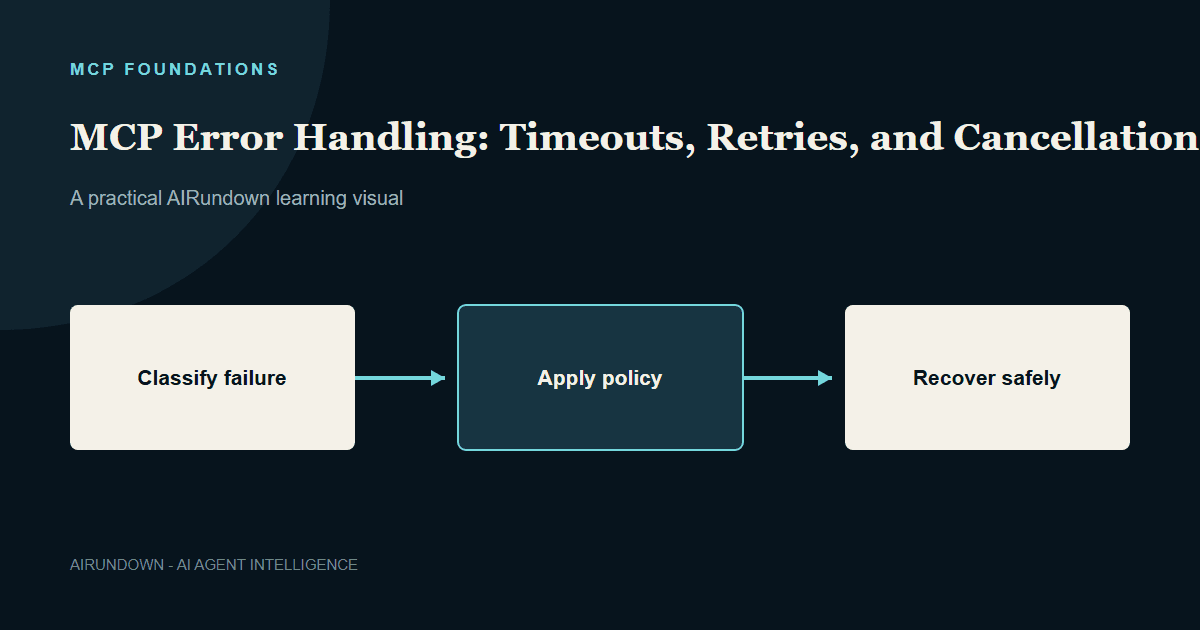
MCP Error Handling: Timeouts, Retries, and Cancellation
A reliability guide to MCP errors, deadlines, retries, cancellation, progress, idempotency, ambiguous writes, and observable recovery.
A reliability guide to MCP errors, deadlines, retries, cancellation, progress, idempotency, ambiguous writes, and observable recovery.
Separate transport failures, protocol errors, and tool-execution failures before deciding what to do.
The practical rule: treat every MCP failure according to what happened, whether the operation may have changed state, and what the user should do next. A blind retry is not reliability.
An MCP integration can fail at several layers. The process might not start. An HTTP request might time out. The peer might reject malformed JSON-RPC. A tool can run correctly yet report that the requested business action failed. A user can cancel while the server is still working. These cases look similar in a chat interface, but they demand different recovery policies.
This guide builds a production-minded model for errors, deadlines, retries, progress, cancellation, and ambiguous writes.
TL;DR
- Separate transport failures, protocol errors, and tool-execution failures before deciding what to do.
- Give every request a deadline, but use operation-specific time budgets rather than one global timeout.
- Retry only transient failures and only when repeating the operation is safe or protected by idempotency.
- Cancellation is a request to stop, not proof that nothing happened.
- When a write has an unknown outcome, reconcile state before attempting it again.
Start with a failure taxonomy
A useful MCP client should classify failures before displaying them or applying automation. Four buckets cover most incidents.
| Failure layer | Example | Typical response |
|---|---|---|
| Transport | Process exits, connection drops, HTTP deadline expires | Reconnect or retry when safe |
| Protocol | Invalid JSON-RPC, unknown method, invalid parameters | Fix the request or compatibility problem |
| Tool result | Tool completes but the business operation fails | Show actionable tool feedback; usually do not retry blindly |
| Policy or user control | Permission denied, approval rejected, user cancels | Stop and explain the boundary |
JSON-RPC error responses contain an integer code, a human-readable message, and optional data. They are different from a successful tools/call response whose content explains that the underlying action could not be completed. That distinction matters: a protocol error says the MCP exchange failed; a tool-level failure says the exchange worked and the application produced a negative outcome.
A client should normalize both into one internal error model without erasing their origin:
{
  "layer": "transport | protocol | tool | policy",
  "retryable": false,
  "operation": "create_invoice",
  "request_id": "req-184",
  "user_message": "The invoice may already have been created. Checking status.",
  "technical_detail": "HTTP response stream closed before result"
}
This structure helps the UI, logs, retry controller, and audit trail agree about what occurred.
Deadlines should reflect the operation
Every outgoing request needs a timeout. Without one, a stalled server can hold sockets, workers, memory, and user attention indefinitely. But a single 30-second default is rarely correct for everything.
A read-only lookup may deserve five seconds. A repository scan may need two minutes. A user-approved deployment could need much longer while still requiring a hard upper bound. Set both an inactivity expectation and an absolute deadline where appropriate.
Progress notifications can justify extending an inactivity timer because they show that work continues. They should not remove the absolute deadline. A broken or hostile server could otherwise emit progress forever. Rate-limit progress updates in the UI and logs so a noisy server cannot create a resource problem of its own.
For each operation, define:
- expected duration and absolute maximum;
- whether progress is supported;
- what happens when the deadline expires;
- whether cancellation is attempted;
- whether the outcome must be reconciled.
Retry only when two questions have good answers
Before retrying, ask: Is the failure likely temporary? and Is repeating this operation safe?
Temporary transport failures, overload responses, and explicitly retryable server conditions may qualify. Invalid parameters, missing permissions, unsupported capabilities, and policy denials normally do not. Retrying those adds load without changing the cause.
Reads are often safe to repeat, although they may still be expensive. Writes are harder. If create_invoice reached the downstream billing system and the response was lost, retrying could create a duplicate. Use an idempotency key when the application supports one:
{
  "customer_id": "cus_123",
  "amount": 4900,
  "currency": "USD",
  "idempotency_key": "invoice-order-7781"
}
The server should persist or forward the key so repeated requests return the original outcome rather than repeating the side effect. If no idempotency mechanism exists, the client needs a separate status or lookup operation before retrying.
Use bounded exponential backoff with jitter for automated retries. Cap both the delay and number of attempts, honor an explicit server retry hint when trustworthy, and never create an infinite retry loop. Record every attempt under one logical operation ID so observability shows a single user action rather than unrelated requests.
Cancellation is cooperative
Cancellation means the requester no longer wants the work to continue. It does not roll back a completed action and it does not guarantee the server stopped in time.
For stdio, the client can send a cancellation notification referencing the active request ID. For Streamable HTTP, closing the response stream is the cancellation signal. The server should stop work and release resources when possible. Race conditions remain normal: completion may occur just before cancellation arrives, or a late response may arrive after the client has stopped waiting.
That leads to three implementation rules:
- Track whether a request is active, cancelling, completed, or outcome-unknown.
- Ignore late responses for user-interface flow, but retain enough telemetry to diagnose them.
- Reconcile externally visible writes after cancellation when completion is uncertain.
The word cancelled should therefore describe the user's intent, not automatically claim that the side effect never occurred. A safer UI message is: “Cancellation requested. We are checking whether the operation completed.”
A concrete failure walkthrough
Imagine an agent calls an MCP tool named publish_article. The CMS accepts the article, but the connection drops before the client receives the result.
The wrong response is an immediate retry. The second call may publish the same article again. The correct flow is:
- Mark the outcome as unknown, not failed.
- Query the CMS using the article slug or idempotency key.
- If the article exists, return the discovered result.
- If it does not exist and the lookup is authoritative, retry within the policy limit.
- If state cannot be verified, ask a human rather than risking a duplicate public action.
This pattern applies to emails, payments, deployments, ticket creation, database writes, and any tool whose side effect survives the MCP connection.
Design errors for humans and machines
A model needs structured facts; a person needs a useful explanation. Return both when you control the tool. Good error data can include a stable reason code, retryability, affected field, safe next actions, and a correlation ID. Avoid leaking secrets, access tokens, raw stack traces, internal filesystem paths, or sensitive downstream responses.
Compare these messages:
Bad:  Something went wrong.
Good: Repository access was denied. Request read access to acme/payments, then retry. Reference: op-4821.
Do not let the language model invent whether an error is retryable. Encode that judgment in server or client policy. The model may explain the policy, but deterministic code should enforce retry counts, allowed operations, deadlines, and approval requirements.
Observability that makes recovery possible
For each call, log the logical operation ID, MCP request ID, server and tool name, attempt number, duration, outcome class, cancellation state, and redacted error details. Trace downstream calls where possible. Metrics should distinguish timeouts, transport resets, protocol errors, tool failures, permission denials, cancellations, retry success, and exhausted retries.
Watch for retry storms. A server outage combined with many clients using identical backoff can turn recovery into a second outage. Jitter, concurrency limits, circuit breakers, and per-server budgets reduce that risk.
Common mistakes
Treating every error as temporary
Permission and validation failures require a changed input or policy. Repetition cannot fix them.
Treating every timeout as a failed write
A timeout only proves the client stopped waiting. The downstream action may have succeeded.
Trusting cancellation as rollback
Cancellation and compensation are different mechanisms. If an operation needs rollback, design an explicit compensating action and secure it like any other write.
Returning raw internal errors to the model
Verbose errors can expose sensitive system details and pollute the context window. Preserve full diagnostics in protected logs and return a safe structured summary.
Hiding all technical detail from users
“Failed” is not actionable. Give the user the consequence, the safe next step, and a reference they can share with support.
Production checklist
- Classify transport, protocol, tool, and policy failures separately.
- Set operation-specific deadlines and absolute maximums.
- Define retryability explicitly; use capped backoff and jitter.
- Require idempotency or reconciliation for important writes.
- Track cancellation races and outcome-unknown states.
- Keep retry and approval controls outside model discretion.
- Redact secrets while retaining correlation IDs.
- Monitor retry volume, timeout rates, late completions, and duplicate prevention.
- Test dropped connections before and after a downstream commit.
- Test cancellation during each important stage of a long-running tool.
My Take
The hardest reliability bug in an agent system is not a clean failure. It is uncertainty after a side effect. MCP gives implementations protocol mechanisms for errors, progress, and cancellation, but application designers must supply the business semantics: what is safe to repeat, how to identify one logical operation, and how to verify an ambiguous result.
Build that policy before adding autonomous retries. A cautious agent that reconciles state is far more useful than a fast agent that confidently performs the same irreversible action twice.
What to learn next
Pair this reliability model with MCP authentication and authorization, then apply both when designing tool schemas. Clear permissions reduce unsafe actions; clear schemas and structured results make failures easier to diagnose and recover.
Sources
- Model Context Protocol specification: Base protocol and error responses
- Model Context Protocol specification: Cancellation
- Model Context Protocol specification: Progress notifications