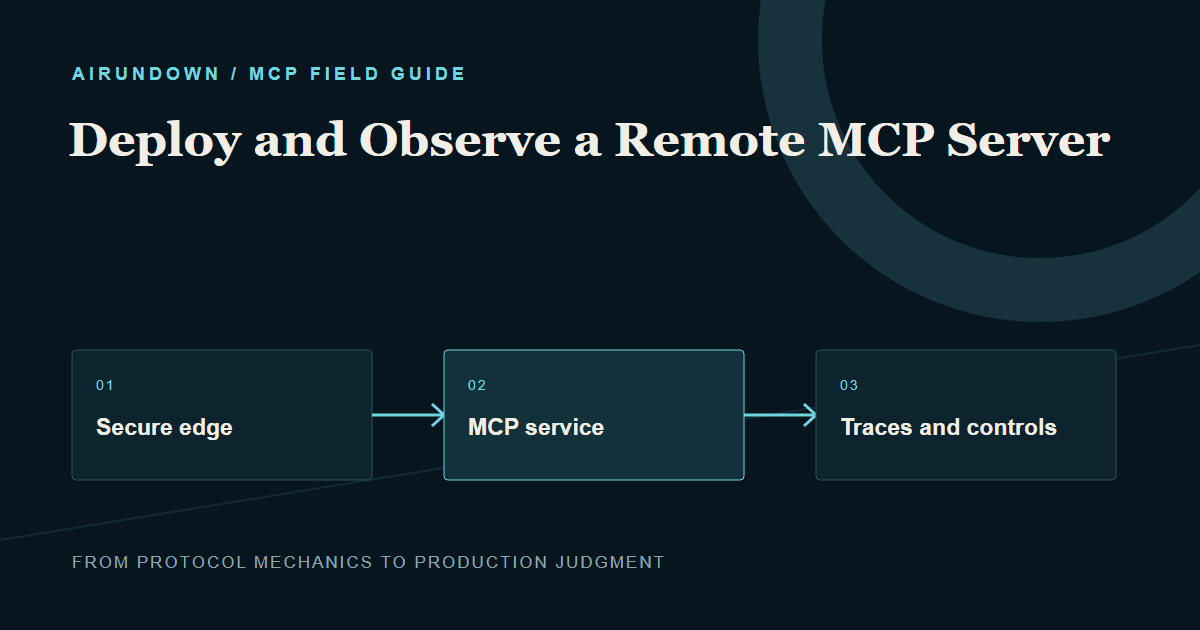
Deploy and Observe a Remote MCP Server
A production deployment guide for remote MCP servers covering network boundaries, identity, scaling, observability, and rollback.
A production deployment guide for remote MCP servers covering network boundaries, identity, scaling, observability, and rollback.
Put the server behind a secure edge with TLS, authentication, request limits, and origin controls.
Outcome: deploy a remote MCP server as a controlled production service—not merely a development endpoint reachable over the internet.
Remote MCP centralizes updates and makes one server available to multiple hosts, but it also introduces network identity, tenant isolation, availability, scaling, and incident-response obligations. Streamable HTTP is the transport layer; production readiness comes from the system around it.
TL;DR
- Put the server behind a secure edge with TLS, authentication, request limits, and origin controls.
- Keep request processing independent and reference durable work with explicit identifiers.
- Propagate user and tenant identity; do not collapse every caller into one administrator service account.
- Observe discovery, tool calls, policy decisions, downstream latency, and side effects as one trace.
- Roll out tools and metadata gradually because contract changes affect model behavior.
Reference architecture
A practical remote deployment includes an MCP host, secure gateway or load balancer, MCP service, authorization and policy layer, secret store, downstream services, durable task system when needed, and centralized telemetry.
The gateway terminates TLS, enforces request-size and connection limits, and routes only the intended MCP endpoint. The service validates protocol messages and credentials. Policy binds the caller to permitted tools, tenants, resources, and environments. Downstream systems retain their own authorization and audit controls.
Do not infer conversation or tenant identity from a long-lived network connection. Carry explicit request metadata and application identifiers. Durable operations should return a task or operation ID that later requests can use for status and reconciliation.
Secure the network edge
Use HTTPS with modern TLS and a trusted certificate. Validate request origins where required by the transport guidance, restrict hosts, and prevent DNS rebinding and cross-origin abuse. Set limits for headers, bodies, concurrent requests, stream duration, and idle connections.
Expose only necessary routes. Administrative health, metrics, and debugging endpoints should use separate protection and often a separate network path. Never place an unauthenticated inspector or verbose diagnostic console on the public internet.
Identity and tenant isolation
For HTTP authorization, follow the current MCP authorization specification and its OAuth-based discovery and token requirements. Validate issuer, audience, expiry, signature, scopes, and resource binding. Do not pass client tokens through to unrelated downstream services.
Derive tenant context from verified identity and server-side membership. Apply tenant filters in data access, caches, queues, object storage, and logs. Test whether identifiers from another tenant can bypass policy. If a downstream API uses a service identity, add a server-side authorization layer that preserves the initiating user and tenant in audit records.
Package and runtime design
Pin dependencies, produce reproducible builds, scan images and packages, and run as a non-administrator identity. Mount the filesystem read-only where possible, provide only necessary environment secrets, block unnecessary outbound destinations, and apply CPU, memory, and process limits.
Separate readiness from liveness. Liveness asks whether the process should be restarted. Readiness asks whether it can safely receive traffic, including required policy and downstream dependencies. Avoid making readiness depend on every optional backend, which can remove all capacity during a partial outage.
Scaling and long-running work
Scale stateless request handling horizontally, but protect constrained downstream services with concurrency budgets and backpressure. Rate-limit by user, tenant, tool, and cost class rather than only IP address. Use bounded queues and reject overload explicitly instead of accepting work that cannot finish before its deadline.
For long operations, use progress notifications when supported while retaining an absolute timeout. Move durable work to a task system and return an identifier. Cancellation should attempt to stop work, but the application must reconcile writes that may already have committed.
What to observe
Logs
Record time, correlation and request IDs, user and tenant pseudonyms, server version, protocol version, capability or tool, policy outcome, duration, result class, retry attempt, cancellation state, and downstream references. Redact tokens and sensitive arguments.
Metrics
Track request volume, active streams, latency percentiles, errors by layer, authorization denials, timeouts, cancellations, retries, queue depth, downstream saturation, tool selection volume, and cost-relevant usage. Separate each tool; an aggregate success rate can hide one broken capability.
Traces
Trace host request through gateway, MCP handling, policy decision, tool execution, and downstream calls. Preserve one logical operation across retries. Trace sampling should retain errors, high-risk actions, and unusual latency without recording confidential payloads.
A safe rollout
Deploy the service dark, then test discovery and direct calls using a non-production identity. Enable a small set of read-only tools for internal users. Compare discovery contracts, errors, latency, and downstream load. Add write tools behind feature flags and explicit approvals. Expand by tenant or user cohort while monitoring denials, retries, and unexpected tool sequences.
Tool descriptions and schemas are behavioral releases because they can change model selection. Version and review them like code. If metadata changes unexpectedly, disable the affected tool or server quickly. Maintain rollback for both runtime and advertised contracts.
Failure and incident planning
Define behavior for authorization outage, downstream slowdown, overloaded queues, partial network failure, secret compromise, and malicious server release. Provide circuit breakers, degraded read-only behavior when appropriate, credential rotation, server revocation, and an audit trail that identifies affected users and actions.
Never silently weaken permissions to preserve availability. A clear unavailable response is safer than falling back to a broader credential or unapproved endpoint.
Production checklist
- HTTPS, endpoint restrictions, origin protections, and request limits.
- Standards-aligned authorization with audience and scope validation.
- User and tenant propagation through every data boundary.
- Non-root runtime, minimal secrets, restricted filesystem and egress.
- Health checks, bounded concurrency, backpressure, and rate limits.
- Operation IDs, timeouts, progress, cancellation, and reconciliation.
- Redacted structured logs, per-tool metrics, and end-to-end traces.
- Contract tests for discovery, schemas, and errors.
- Gradual rollout with feature flags and approval gates.
- Runtime, metadata, credential, and server-revocation rollback plans.
My Take
A remote MCP server is an authorization and operations product wrapped around protocol capabilities. The code that exposes a tool may be small; the production system that makes it safe, observable, and reversible is the real implementation.
Start with one coherent domain and a narrow read-only surface. Earn broader authority through evidence from tests, telemetry, and incident drills.
Sources
- Model Context Protocol specification: Streamable HTTP transport
- Model Context Protocol specification: Authorization
- Model Context Protocol specification: Errors, progress, and cancellation